As a mission-based cooperative lender and member of the Farm Credit System, CoBank is committed to serving as a good corporate citizen. The bank maintains a variety of corporate social responsibility programs primarily focused on rural America and the vitality of rural communities and industries.
We deliver vital support for the U.S. rural economy, providing financial services to agribusinesses and rural power, water and communications providers in all 50 states. It's who we are and what we believe in. Join us.
The U.S. is experiencing its fastest electricity demand growth since World War II.
The Department of Energy is now using its emergency authority under the Federal Power Act to direct FERC to quickly standardize large-load interconnections.
Though they could expedite grid access for major customers, these reforms may compromise local utility investment and state regulatory authority, emphasizing the importance of coordinated planning.
In 2025, the U.S. government declared a “national energy emergency,” citing an unprecedented surge in electricity demand driven by AI data centers, manufacturing and electrification. Following 20 years of very little demand growth, electricity consumption in the nation has been increasing at its most rapid pace since World War II. After rising 2.6% in 2024, electricity sales to ultimate customers are on track to increase 2.4% in 2025 and 2.6% in 2026, according to the U.S. Energy Information Agency’s latest guidance. This growth is particularly concentrated in the West South-Central region (including Texas, Oklahoma, Louisiana and Arkansas) where sales will grow by 9.2% in 2026. Much of the growth is due to new data centers and cryptocurrency mining facilities that are coming online or are expected to come online in ERCOT.
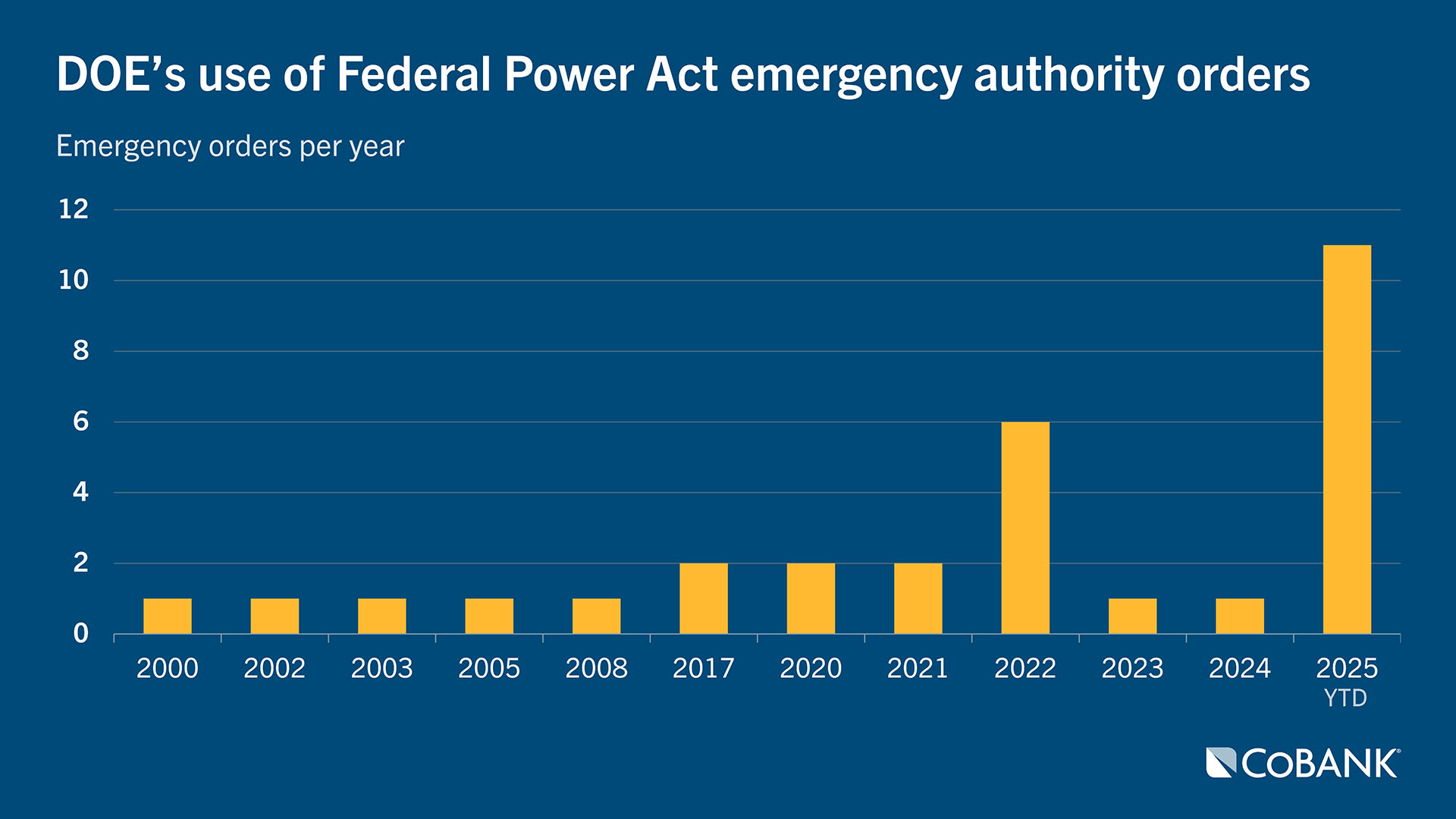
Yet, the electricity industry’s existential crisis isn’t data centers’ need for power but rather the inability of the existing grid to provide enough reliable power when it is needed. Last July, the Department of Energy warned that blackouts could increase by 100 times in 2030 if the U.S. fails to add additional firm capacity. Acknowledging that the magnitude and speed of projected load growth cannot be met with existing approaches, DOE asserts that “radical change is needed,” warranting use of the agency’s emergency authority under Section 202(c) of the Federal Power Act. Section 202(c), sometimes called the “emergency powers” provision, is a powerful tool for the federal government to ensure grid reliability during extraordinary circumstances. It grants the DOE authority to order temporary connections, generation, delivery, interchange or transmission of electricity during a national emergency.
Source: U.S. Department of Energy Office of Cybersecurity, Energy Security and Emergency Response
The DOE’s more frequent and expansive use of the Federal Power Act in 2025 signals a major shift in U.S. electricity policy—moving from a reactive stance to a proactive national approach to grid reliability and modernization. Further evidence of this shift is the agency’s more expansive use of Section 201(b) of the Federal Power Act to justify accelerated federal rulemaking to facilitate faster grid access for data centers.
The DOE’s recently issued Advanced Notice of Proposed Rulemaking directs the Federal Energy Regulatory Commission to initiate rulemaking that would standardize and expedite the process for interconnecting large loads such as data centers directly to the interstate transmission system, asserting this authority under the Federal Power Act. DOE claims that FERC's power over the transmission of electric energy in interstate commerce and the sale of electric energy at wholesale in interstate commerce logically extends to regulating the interconnection of large loads with interstate transmission. In the DOE letter, discussing the novel use of Section 201(b), Secretary Wright maintains that asserting “commission jurisdiction is in the public’s interest”.
The DOE’s ANOPR requests that FERC take final action and put a rule in place by April 30, 2026. This is a notably accelerated timeline compared to typical federal rulemakings, reflecting the urgency the DOE sees in addressing the rapid growth of large loads.
Why this matters…
If adopted, these reforms would mark a major shift in how large, energy-intensive customers, especially data centers, connect to the grid. Viewed in the most restrictive light, the ANOPR could disrupt the current pace of local electric distribution investment. How? The ANOPR could potentially enable large loads to bypass local utilities, reducing incentives for local grid modernization and potentially increasing costs and risks for remaining customers.
Admittedly, the interconnection of large loads has traditionally been regulated by state public utility commissions, resulting in a patchwork of rules and approval processes that vary widely across states and even among utilities within the same state. Yet, bypassing state coordination is probably not the answer.
To be sure, there are challenges for coordinated grid governance. The Federal Power Act separates FERC’s oversight of wholesale sales from state regulation of retail rates. This situation presents complexities, as effective large-load supply management requires a high level of coordination between retail and wholesale regulated players to ensure that service risks are not simply transferred upstream on the grid. The absence of a unified regulatory framework is a factor that without a doubt affects the pace of data center development. Yet, federal-state regulatory coordination is critically important. In our opinion, faster, more reliable data center grid connections are achievable through unified planning, shared risk management, flexible interconnection agreements, transparent processes and strong federal-state-local coordination.
Disclaimer: The information provided in this report is not intended to be investment, tax, or legal advice and should not be relied upon by recipients for such purposes. The information contained in this report has been compiled from what CoBank regards as reliable sources. However, CoBank does not make any representation or warranty regarding the content, and disclaims any responsibility for the information, materials, third-party opinions, and data included in this report. In no event will CoBank be liable for any decision made or actions taken by any person or persons relying on the information contained in this report.
Stay ahead of the game in your field. Subscribe today.
Get CoBank's industry-leading Knowledge Exchange research reports delivered straight to your inbox as soon as they're released.
Have a comment or question about these reports?
Contact CoBank's Knowledge Exchange team to ask questions, engage with analysts or receive additional information.